
Two guns chase the exact same idea from opposite directions: a short, suppressor-ready .300 Blackout carbine that can replace a subgun like the HK MP5SD. The Q Honey Badger got there first and wears a premium price tag for it. The PSA Sabre Mixtape showed up years later aiming at the same target, built to get most shooters most of the way there for about half the money.
Born at AAC, for an Elite Unit
The concept started at Advanced Armament Corporation, where founder Kevin Brittingham wanted “the ease of use of an AR-15, but the portability of an MP5.” AAC’s R&D team built the original Honey Badger around 2011 at the request of an elite special operations unit looking to retire its MP5SDs for something built on the AR platform instead, without losing the suppressed, close-quarters performance that made the MP5SD so trusted.[1]
AAC Exits, Q Picks It Up Again
That original Honey Badger was never sold commercially. AAC’s owners decided in 2013 to get out of the rifle business entirely and focus only on suppressors, shelving the project. Brittingham left and founded Q in 2017, bringing an improved version of the Honey Badger to market himself, now chambered in both .300 Blackout and 5.56 NATO, and paired with Q’s own suppressors and muzzle devices.[1]
A 2020 Brush With the ATF
The category has always been legally fragile, and the Honey Badger ran straight into that in 2020. On October 6, the ATF sent Q a cease-and-desist letter reclassifying the Honey Badger pistol as a short-barreled rifle. Q suspended production eight days later and declined a 60-day reprieve the agency offered, saying it feared the suspension could be pulled at any time. It’s the same regulatory gray zone braced pistols have sat in for years.[1]
Why .300 Blackout, Specifically
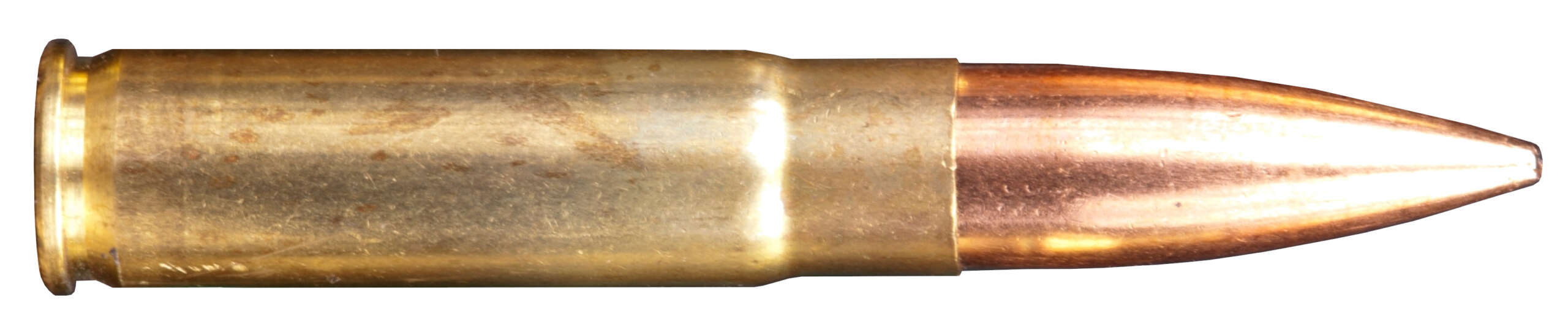
Both guns lean on the same cartridge for a reason. .300 AAC Blackout was engineered specifically to solve a problem: standard 5.56 rounds get loud and lose reliability when fired subsonic out of a short, suppressed barrel. A heavier .300 Blackout subsonic load, typically 200 to 220 grains, stays below the sound barrier and still cycles a standard AR bolt carrier reliably, which is exactly what a quiet, short-barreled platform needs.[1]
What the Honey Badger Brings to the Table
The current Honey Badger pairs a 7-inch barrel with Q’s own Cherry Bomb muzzle device, built to accept a quick-detach suppressor without re-zeroing. It weighs just 4.6 pounds and runs 20.9 inches long collapsed, short enough to work comfortably inside a vehicle or doorway. An adjustable gas block under the M-LOK handguard and a two-piece bolt carrier group with a shortened buffer stroke help tame recoil at that reduced barrel length.[2]
No freely licensed photo of the Honey Badger itself turned up to use here — it’s a newer, lower-volume gun, and neither Q nor an outside photographer has released one under an open license. We’re not substituting a stock photo or a dealer image for it; see it on Guns.com instead.
PSA’s Answer: the Sabre Mixtape
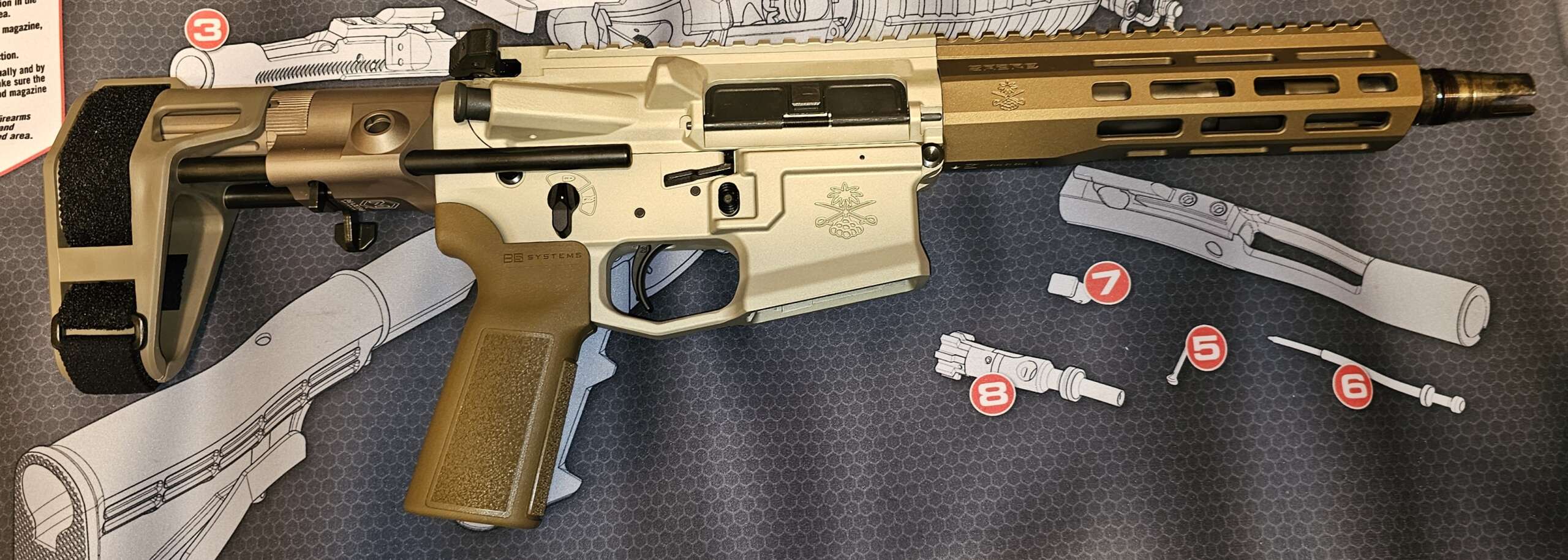
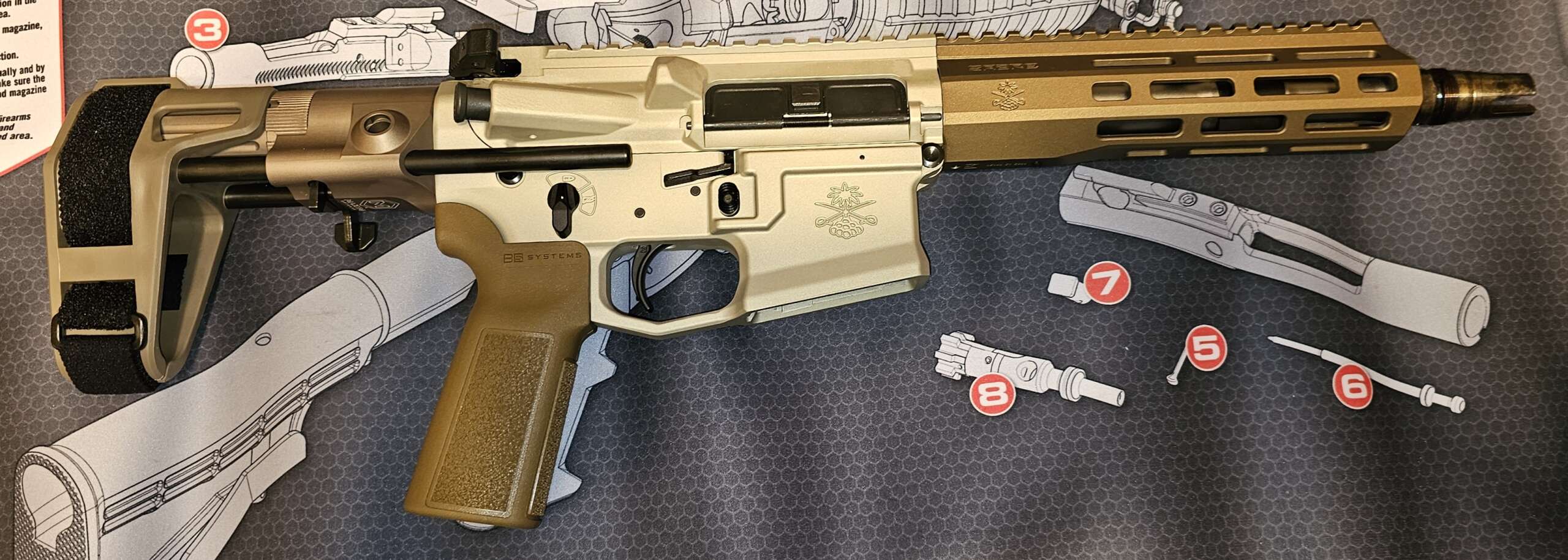
Palmetto State Armory built the Sabre Mixtape with an explicit target in mind: take everything that makes the Honey Badger concept work and sell it for roughly half the price. PSA’s own marketing calls it “PSA’s clearest shot yet at the premium PDW market,” and the parts list backs that up, leaning on name-brand components rather than PSA’s own budget parts to get there.[3]
The Sabre Enhanced Mixtape Vol. 1 runs an 8-inch, 416R stainless barrel with a 1:5 twist, fast enough to stabilize heavy subsonic .300 Blackout bullets, paired with a 17-position adjustable gas block for suppressor tuning. PSA built it around genuinely premium third-party parts: a Radian Raptor LT charging handle and Talon safety, a B5 Systems grip, a two-stage Sabre Claw trigger, and a Maxim Defense CQB brace.[3]
Side by Side
Set side by side, the family resemblance is obvious. Both use fast 1:5-twist barrels tuned for heavy subsonic loads, both offer adjustable gas systems for running suppressed, both ship with two-stage triggers and ambidextrous controls, and both are built on AR-pattern lowers that take standard STANAG magazines. The Mixtape didn’t happen by accident; it’s a direct answer to the gun Q built first.[3]
| Feature | Q Honey Badger | PSA Sabre Mixtape Vol. 1 |
|---|---|---|
| Barrel Length | 7 in | 8 in |
| Barrel Twist | 1:5 | 1:5 |
| Muzzle Device | Q Cherry Bomb | Sabre Plan B 3-prong |
| Trigger | AR Gold (2-stage) | Sabre Claw (2-stage) |
| Brace | Q-pattern collapsible | Maxim Defense CQB |
| MSRP | ≈ $2,399 | $1,249.99 |
Where the Money Actually Goes
The price gap comes down to where the money goes. The Honey Badger’s AR Gold trigger and in-house finish work push it toward $2,399, and buyers are paying for Q’s original engineering and more refined fit. PSA’s approach stacks roughly $700 worth of name-brand parts onto a receiver set it builds itself for around $550, landing the Mixtape at $1,249.99 without resorting to PSA’s own budget-tier components throughout.[3]
Which One Should You Actually Buy
The Honey Badger still makes the most sense for buyers who want the original design, the most refined trigger, and the tightest overall fit, and who don’t mind paying nearly double for it. The Mixtape makes sense for almost everyone else: shooters who want a genuinely capable suppressed .300 Blackout PDW, built around premium third-party parts rather than an all-budget build, without spending Q-level money to get there.
Strip away the price tags and both guns are chasing the same ghost: a shoulder-fired gun short enough for a vehicle, quiet enough for close work, and reliable enough to trust with heavy subsonic .300 Blackout. Q got there first and still sells the more refined version of the idea. PSA just proved the idea didn’t have to stay that expensive to work.
Sources
- [1] Wikipedia — AAC Honey Badger
- [2] Guns.com — Q Honey Badger Review: Suppressor-Optimized AR
- [3] Lynx Defense — PSA Sabre Mixtape Vol 1 Review: 300 BLK Tested