
Long before John Moses Browning's name became shorthand for pistol design itself, he produced two very different answers to the same question: how should a semi-automatic sidearm serve a soldier? The Colt Government Model 1911 and the Browning Hi-Power emerged roughly two decades apart, one an American response to jungle warfare, the other a European request for firepower. Comparing them side by side reveals two philosophies wearing the same designer's fingerprints.
A Pistol Born in the Philippines
The 1911's origin traces to the Philippine–American War, where the U.S. Army's .38-caliber revolvers were judged too weak against determined Moro fighters. The Army wanted a larger-caliber self-loading pistol, and Colt engineer John Browning reworked an existing autoloading concept around a new .45-caliber cartridge of his own design, setting the stage for the trials that would follow. [1]
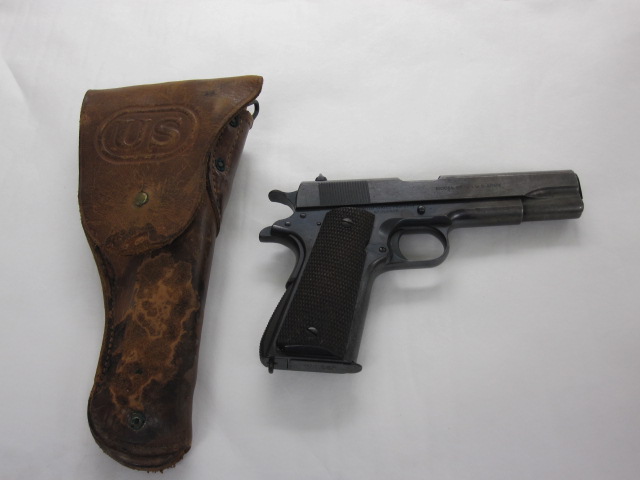

Colt's pistol won the Army's 1911 trials outright and was formally adopted on March 29, 1911, with the Navy and Marine Corps following in 1913. Combat experience in the trench warfare of World War I exposed a handful of ergonomic shortcomings, and the Army's fixes, finalized in 1924, produced a revised pistol reclassified as the M1911A1 in 1926. [1], [2]
How the 1911 Actually Works
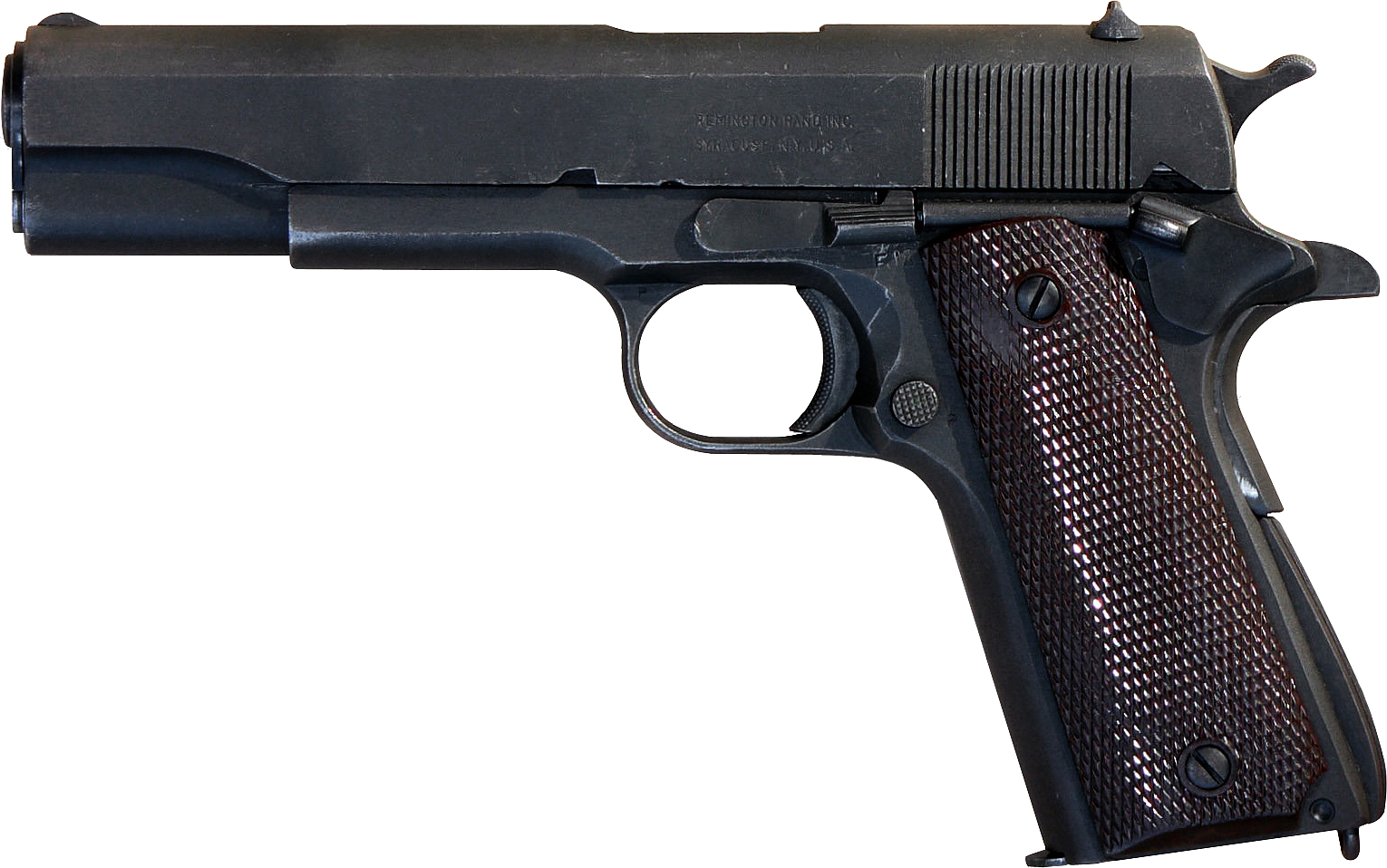
Mechanically, the 1911 is a short-recoil-operated, single-action semi-automatic with a locked breech, meaning the barrel and slide travel together briefly before unlocking. It layers redundant safeties onto that simple foundation: a grip safety that must be squeezed to fire, a manual thumb safety, and a half-cock notch, all wrapped around a trigger built for a crisp, consistent break. [2]
As originally adopted, the 1911 carried a 5-inch barrel, fed from a 7-round single-stack magazine of .45 ACP, and weighed roughly 2 pounds 7 ounces unloaded. Colt's civilian and military production never fully stopped after 1911, and after 1970 the platform began accumulating the trigger, sight and finish variations that define the modern custom 1911 market. [1], [2]

A Belgian Answer to French Demands
The Hi-Power's story starts differently: in the early 1920s, the French military asked for a service pistol with a large-capacity magazine and a low-profile external hammer. Browning filed a patent for the concept in 1923 and built working prototypes, but he died in 1926, years before FN Herstal's own designer, Dieudonné Saive, carried the project to a finished, production-ready pistol. [3]
By 1931, Saive's evolving design had settled on a curved rear grip strap and a barrel bushing built into the slide itself, and by 1934 the pistol was ready for the factory floor. FN named it the "Grande Puissance," or High Power, for a magazine capacity nearly double that of contemporaries like the Walther P38 or the Colt 1911 it was partly measured against. [3]
| Feature | Colt Government Model 1911 | Browning Hi-Power |
|---|---|---|
| Country of origin [1], [3] | United States | Belgium |
| Introduced [1], [3] | 1911 | 1935 |
| Cartridge [1], [3] | .45 ACP | 9×19mm Parabellum |
| Magazine capacity [1], [3] | 7 rounds, single-stack | 13 rounds, double-stack |
| Operating mechanism [2], [3] | Short recoil, single action, grip safety | Short recoil, single action, no grip safety |
| Weight, unloaded [1], [3] | approx. 2 lb 7 oz (1.1 kg) | approx. 32 oz (915 g) |
| Overall length [1], [3] | 8.25 in (210 mm) | 7.8 in (199 mm) |
| Current status [4], [5] | In continuous production since 1911 | Original discontinued 2017; FN High Power reintroduced 2022 |
The Double-Stack Breakthrough
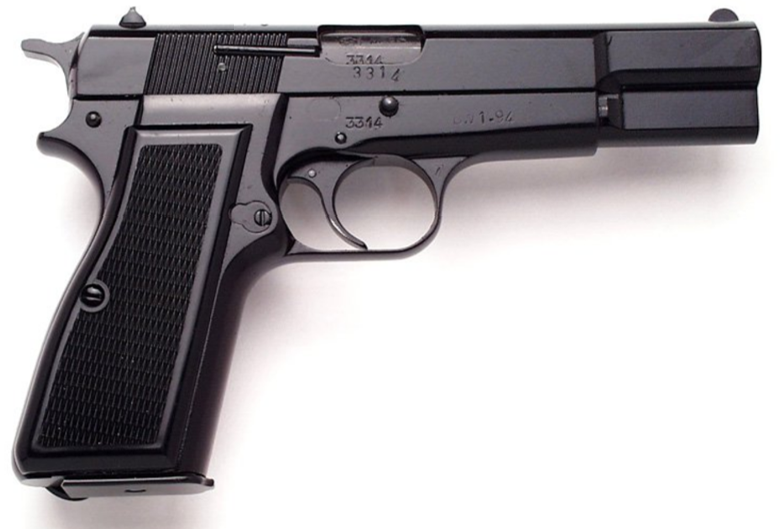
What made the Hi-Power genuinely new was its 13-round double-stack magazine, a first for a successful military service pistol chambered in 9mm Parabellum. No other double-stack 9mm design reached the market until the MAB PA-15 arrived three decades later in 1966, leaving the Hi-Power without real competition in magazine capacity for most of its early service life. [3]
FN formally adopted the pistol for the Belgian military as the P35 in 1935. From there it spread further and faster than the 1911 ever did commercially, eventually arming police and military forces in more than fifty countries and becoming one of the most widely issued handguns of the twentieth century, a reach the more nationally-bound 1911 never matched. [3], [4]
.png)
Two Different Trigger Philosophies
Despite sharing a short-recoil design lineage, the two pistols diverge sharply in feel: the Hi-Power dropped the 1911's grip safety entirely, relying only on a manual thumb safety, and its single-action trigger is typically heavier and less crisp than a well-tuned 1911's due to the added mechanical linkage the magazine disconnector and larger frame required. [2], [3]
The core tactical argument between them is really a philosophical one: the 1911 bet on a large, slow-moving .45 ACP bullet with limited ammunition capacity, while the Hi-Power bet on a smaller, faster 9mm round paired with nearly double the rounds on tap. Both approaches found devoted institutional believers for the rest of the century. [1], [3]
Parallel Service Records
The 1911A1 remained the U.S. military's standard sidearm until 1985, when the Beretta M9 replaced it after 74 years of continuous issue, an extraordinarily long service life for any firearm. The Hi-Power, meanwhile, outlasted it in NATO-adjacent service well into the 21st century, remaining a standard-issue pistol for the British Army and other Commonwealth forces for decades after Colt's design had already been retired stateside. [1], [4]
Where They Stand Today
Colt, along with dozens of other manufacturers, still produces 1911-pattern pistols in enormous variety, from historically faithful reproductions to heavily customized competition guns, keeping the platform in continuous production since 1911 without interruption. The Hi-Power's story is more complicated: after 82 unbroken years, Browning Arms discontinued the original in 2017, closing out one of the longest production runs in firearms history. [4], [5]
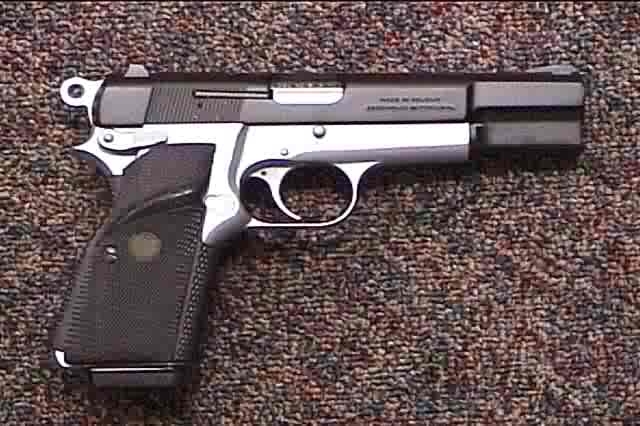

FN reversed that discontinuation in 2022, reintroducing the pistol as the FN High Power with a largely new internal design: an ambidextrous slide lock, a simplified takedown procedure, a wider ejection port and a 17-round flush-fit magazine. It resembles the original Saive design closely but omits the classic Browning-style locking lugs, making it a tribute in silhouette more than a direct continuation. [5], [6]
The Common Thread
Set next to each other, the two pistols read less like competitors and more like siblings raised in different households: the same recoil-operated DNA, the same designer's early hand, but opposite conclusions about capacity, trigger feel and what a soldier's sidearm should prioritize. That disagreement, worked out across two decades and an ocean, still shapes how modern service pistols get designed. [3]
Sources
- Colt 1911 Government Model And Beyond — Gun Digest
- Colt Government Model Is a 1911 That's All Business — Rock Island Auction
- Browning Hi-Power — Wikipedia
- The Browning Hi-Power: Why a 90-Year-Old Design Still Inspires New Generations — AmmoLand
- The FN Hi-Power Is Reborn — The Firearm Blog
- FN Has Re-entered the Hi-Power Game — Guns.com