Some firearms earn their fame through a single dramatic moment; the Smith & Wesson Model 10 earned its through sheer, unglamorous persistence. Over more than a century in production, it became the sidearm most American police officers actually carried, the revolver soldiers relied on when a rifle wasn't practical, and quite possibly the single most-manufactured centerfire handgun the world has ever seen.

A New Cartridge Looking for a Home
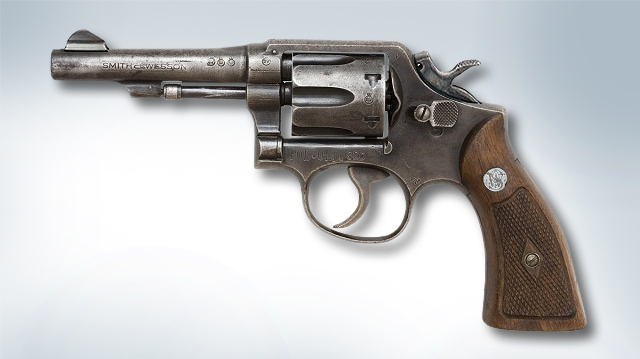
The Model 10's story begins in 1899, when Smith & Wesson introduced the .38 Hand Ejector as a vehicle for a new cartridge: the .38 Special. It was the company's first swing-out-cylinder revolver built on what became known as the K-frame, a mid-size platform sized specifically to balance the new round's recoil against a grip most hands could manage comfortably. [1], [2]
That K-frame architecture borrowed one detail directly from a Colt design: a cylinder-release latch mounted on the frame's left side, operated by the thumb rather than requiring the shooter to break the gun open. It was a small mechanical choice, but it shaped how two generations of American police holsters and training doctrine were built around this specific revolver's manual of arms. [1]
From Hand Ejector to Military & Police
As law enforcement agencies adopted the .38 Hand Ejector through the early 1900s, Smith & Wesson leaned into that market and renamed the gun the "Military & Police" model, a name that stuck informally for decades even after the company assigned it the numeric designation Model 10 in 1957, when its naming system was overhauled. [1]
A War Contract Under a Different Name
When Britain needed handguns quickly early in World War II, an initial attempt to have Smith & Wesson build a new carbine design fell through on inspection standards, and the two sides settled on something simpler: mass-producing the existing K-frame Military & Police revolver, chambered for .38 S&W, at a reduced wartime price. [3]
Produced between 1942 and 1944 and marked with a distinctive "V" prefix ahead of the serial number, these Lend-Lease revolvers earned the nickname "Victory Model," with more than half a million shipped to the United Kingdom, Australia, Canada, New Zealand and South Africa. Their service outlasted the war itself: American combat aircrews carried .38-caliber K-frame revolvers as personal survival sidearms through Korea, Vietnam, and even the opening phase of the Gulf War. [3]
What the Model 10 Actually Is
Mechanically, the Model 10 is a conventional double-action revolver: a six-round cylinder chambered in .38 Special, a swing-out cylinder released by that left-side thumb latch, and fixed sights milled directly into the top strap and front of the barrel rather than adjustable target sights. It can be fired double-action with a long trigger pull or cocked for a lighter single-action press. [1], [2]
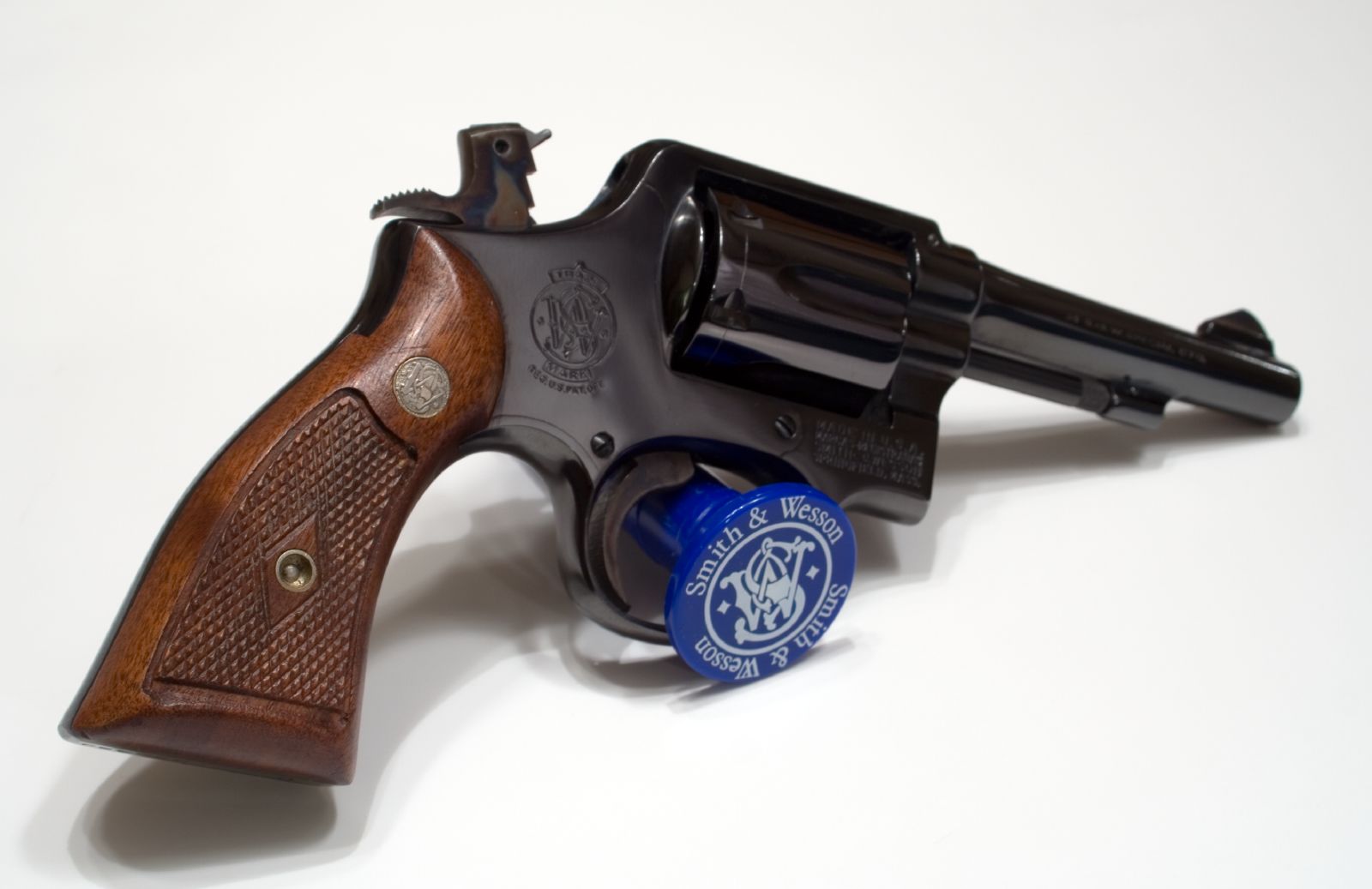

Barrel length turned out to be the platform's most flexible feature. Over its production run Smith & Wesson offered the Model 10 with barrels as short as 2 inches for concealment and plainclothes work, and as long as 6 inches for uniformed patrol and target use, with 3, 4 and 5-inch lengths filling in between depending on the era and the buyer. [1]
A Standard-Issue Sidearm for Most of a Century
By the mid-20th century, the Model 10 had become the default sidearm for a huge share of American municipal and state police departments, prized less for any single standout feature than for its reliability, its manageable size, and a cartridge that was accurate and controllable without being punishing to train with over a long career. [1], [2]
That dominance began to erode in the 1980s and accelerated through the 1990s, as departments across the country traded their six-shot revolvers for higher-capacity semi-automatic pistols, a shift driven largely by well-publicized shootouts where officers found themselves outgunned by suspects carrying magazine-fed handguns. The Model 10 didn't disappear so much as gradually stop being anyone's first issue. [1]
A Platform, Not Just One Gun
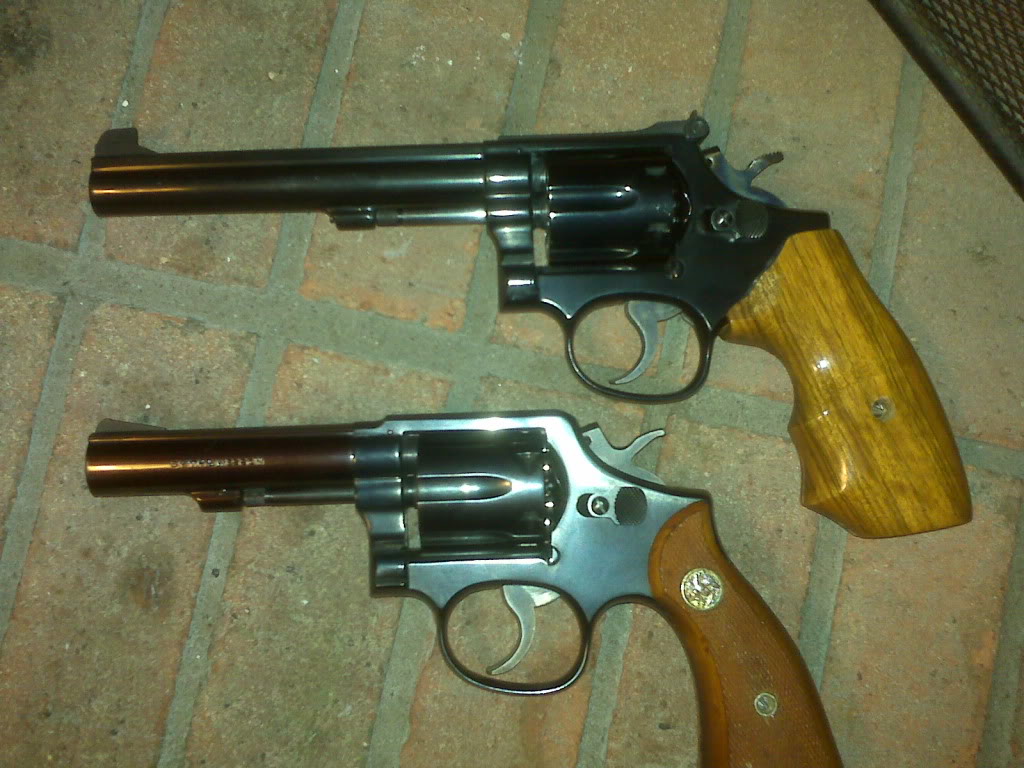
The Model 10's K-frame became a foundation Smith & Wesson reused repeatedly: the Model 14 shares the same frame in a target-sighted configuration built for bullseye competition, while other K-frame descendants extended the family into different sight setups, finishes and even different chamberings, all recognizably built on the architecture the Model 10 established. [4]
That shared lineage means two Model 10-family revolvers can look meaningfully different despite carrying the same underlying frame: a fixed-sight duty gun with plain wood grips sits right next to a target-sighted, adjustable-rear-sight sibling clearly meant for a shooting bench rather than a holster, yet both trace back to the same 1899 design decision. [4]

Where It Stands Now
Production numbers for the Model 10 are difficult to pin down precisely because Smith & Wesson kept building it, with only incremental changes, for so long, but estimates put total output at somewhere north of six million units, a figure that likely makes it the best-selling centerfire revolver design in history. [1]
Smith & Wesson has never fully discontinued the K-frame concept, and Model 10s and their close relatives remain in production or recent memory in various configurations, still bought today by collectors, retired officers replacing a duty gun they trained on, and shooters who simply want a well-proven double-action revolver without chasing a specific collector variant. [1], [2]
A Century of Quiet Competence
What the Model 10 offers, more than any single technical innovation, is an unbroken thread: the same basic K-frame revolver that police officers carried on 1930s beats also rode in WWII aircrew holsters, walked American streets through the Cold War, and still sits in gun safes today, a plain, honest design that simply kept doing its job long after flashier guns came and went.